春日
Climate Gambit: Chinese team develops ‘super brain’ to guide flood precautions using weather, hydraulic and terrain data_我的网站

一 | 清晨八点,四川绵阳江油市解放北路,张伟准时打开店门、擦拭柜台、整理票据,动作干脆利落,一如当年军营里整理内务的模样。

二 |
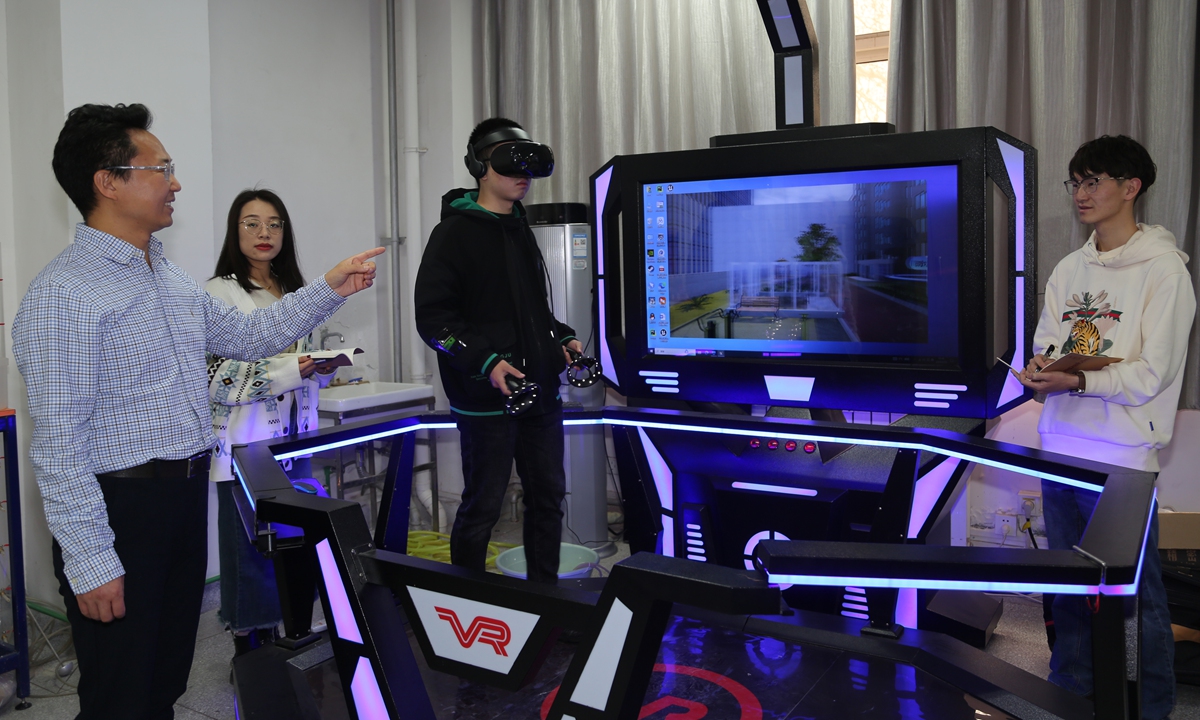
Students from Xi'an University of Technology test a virtual reality-enabled emergency evacuation simulation system tailored for flood disasters on January 12, 2024. Photos: Courtesy of Xi'an University of Technology
Editor's Note:Extreme weather is increasingly a global challenge, and the key to addressing climate risks lies in earlier prediction, more precise action and smarter preparedness, with emerging technologies playing a vital role. The Global Times launches the "Climate Gambit" series, exploring how research teams are leveraging cutting-edge technologies, including artificial intelligence, high-performance computing and smart observation systems, to anticipate weather changes, enhance disaster early-warning and strengthen resilience against climate risks.
Inside a state key laboratory at Xi'an University of Technology, Northwest China's Shaanxi Province, there is a miniature but complete "water world" which simulated water channels, inland lakes and main rivers to recreate real flood scenarios and test their newly developed GPU Accelerated Surface Water Flow and Transport Model (GAST).
Known as a "super brain" for flood control, GAST can complete flood simulations involving more than 3 million computational units within 30 seconds, helping transform flood management from a reaction to emergency into active precautions since "flooding impacts can be predicted even before rainfall arrives."
At a time when extreme rainfall and summer flooding have become increasingly frequent, questions such as when the flooding will arrive, which roads may be submerged and when residents should evacuate have become increasingly important.
In an exclusive interview with the Global Times, Hou Jingming, a professor at Xi'an University of Technology and the leader of the research team, explained how the GAST model seeks to answer these questions by accurately predicting flood development and identifying vulnerable areas before disasters occur, and how the model helps authorities take preventive measures to reduce casualties and economic losses.
AI empowering 'flood drill' The water tank system in the lab was designed to create a controllable, repeatable and observable environment to simulate complex hydrological processes, including river flooding, urban water level changes, lake regulation, drainage pump operations and coordinated flood-control measures.
By adjusting variations such as upstream water inflow, rainfall intensity, downstream water levels and drainage conditions, scientists can recreate different flood scenarios. Meanwhile, water levels, flow speeds and other data are collected in real time and displayed on a digital twin platform.
"If a rainstorm and corresponding floods are an exam, GAST is like a 'drill,'" Hou said. "It can simulate how floods develop, where water will flow, which areas may be inundated and when river levels may rise, ensuring authorities are well but not overly prepared."
To answer the public's concern about "whether my neighborhood will be flooded when heavy rain arrives," the team developed new algorithms for urban surface water flow, including improvements in terrain slope and friction calculations.
These breakthroughs have improved simulation accuracy in complex urban environments. Compared with extensive monitoring data, GAST can keep simulation errors of key hydrodynamic factors within 15 percent. This means the model can provide not only general flood trends, but also quantitative information such as water depth, flow speed and inundation areas.
Combined with AI technologies, it can identify complex relationships between rainfall, water conditions, flood depth, flow velocity and affected areas, cutting simulations from hours in traditional methods to minutes or even seconds.
The faster calculation capability means that once meteorological authorities update forecasts, the model can quickly estimate flood risks in different parts of a city.
"The earlier rainfall warnings are issued, the earlier we can identify potential flooding hotspots and high-risk areas," Hou said. "This saves valuable time for evacuation, traffic management and emergency deployment."
For smarter disaster response
Building an accurate flood prediction model also requires integrating large amounts of urban data other than weather forecasts, including urban terrain, drainage networks and infrastructure information.
For example, a model developed for Xi'an incorporates geographic data and drainage system information collected from relevant authorities and field surveys. After receiving rainfall forecasts, the system can quickly calculate possible flooding scenarios, showing when and where waterlogging may occur and highlighting vulnerable roads and areas through visual maps.
To demonstrate how the super brain works in case of possible flooding, the laboratory has set a virtual reality area where visitors can experience a simulated urban flooding evacuation in the Xiaozhai area of Xi'an. Wearing VR headsets, participants can see water levels gradually rising and follow emergency instructions to move toward higher ground.
The entire technological package has already been applied in real-world flood prevention.
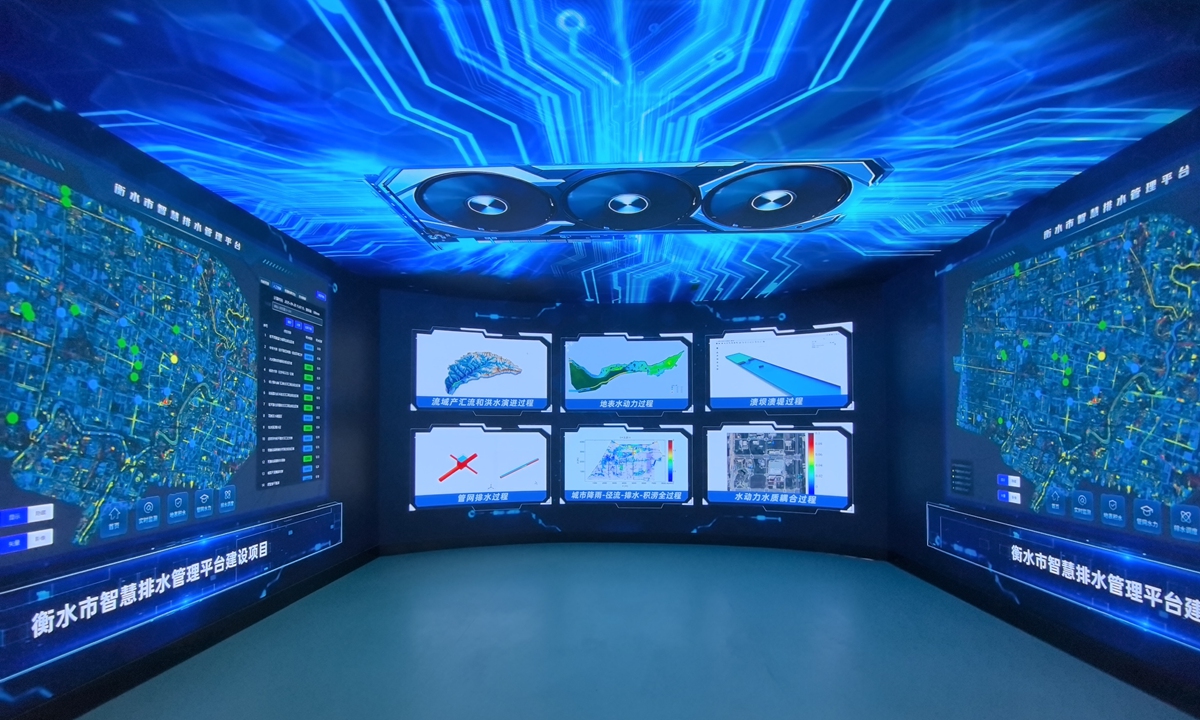
A 3D live-scene display lab in Xi'an that oversees stormwater drainage performance in Hengshui, North China's Hebei Province Photos: Courtesy of Xi'an University of Technology
During Typhoon Muifa in 2022, Haishu district in Ningbo, East China's Zhejiang Province, recorded a regional rainfall of 367 millimeters. Using GAST as its core technology, the local flood forecasting platform integrated weather forecasts, AI algorithms and real-time monitoring data to provide rolling three-hour flood risk predictions.
Post-event assessments showed that predicted risks at most locations matched actual flooding conditions. The average relative error between predicted and observed maximum water depths was 13 percent.
The GAST model was also integrated into a smart rain and flood management platform in Qinhan new city area in Xianyang of Shaanxi, and during a rainstorm warning in July 2022, the platform provided continuous monitoring and forecasts. Based on the results, local authorities shifted from routine inspections to targeted monitoring of flood-prone areas and optimized emergency drainage operations.
The model is also being applied to mountain torrent prevention, as it can simulate rapidly changing flows in complex terrain and, combined with machine learning, complete forecasts within seconds. For reservoirs and rivers, it supports sudden and gradual dam-break simulations.
In June 2026, the model was presented at a national symposium on flood risk mapping achievements. The technology has since been applied by water resources, emergency management and urban development authorities, expanding from Shaanxi to multiple provinces and regions across China.
Looking ahead, the research team is developing a framework that further keeps up with the pace focusing on AI technologies. "Currently, the system operates based on weather forecast, therefore, AI will increase efficiency by using historical cases and real-time monitoring data to correct errors and update forecasts dynamically," Hou said.
。穿上军装,他守护一方河山;脱下军装,他传递一份善意。
五年军旅,淬炼一生底色2006年,张伟应征入伍,成为武警某师的一名战士。服役期间,他于2008年至2009年走进武警福州指挥学院学习深造,2010年因表现突出担任班长。五年军营磨砺,“有责任、有担当,讲团结、重情义”刻进了他的骨子里,也养成了他直爽坦诚、干脆利落的行事作风。“在部队,令行禁止是天职,诚实守信是本分。”回望军旅,张伟说,部队教会他最重要的事,是敬畏规则、坚守诚信。这份军人底色,成为他此后每一段职业旅程的精神坐标。
转身再出发,换个“战位”继续站岗2011年退伍后,张伟远赴新疆参加工作,2021年回到家乡在基层一线岗位上磨砺了两年。2023年6月,他作出人生又一次重要选择——投身福彩事业,成为江油市解放北路第51070404号福彩销售网点的代销者。隔行如隔山。

三 | 开业之初,玩法不熟、不会介绍、客源稀少,店里常常一坐就是一整天。困难面前,军人那股不服输、肯钻研的劲头上来了:不懂的,就向片区管理员和经营多年的前辈虚心请教;没人进店,他就先给亲朋好友发消息,告诉大家“我在做福彩”。盛夏时节白日炎热、行人稀少,他就抓住傍晚市民纳凉散步的时机,把刮刮乐摆到店门外,让街坊邻里知道“这里开了一家福彩店”。靠着这股韧劲,小店渐渐有了人气,经营逐步走上正轨。把“规矩”刻进日常,用诚信赢得托付从军营到小店,变的是岗位,不变的是对规则的敬畏。经营中,张伟严格执行责任彩票各项管理规定:不向未成年人售彩,遇到年轻面孔主动核实年龄;面对大额购彩,主动了解购彩者情况,耐心劝导量力而行、理性购彩;兑奖时,票据、流程、纳税事项一一交代清楚。“福彩是公益事业,购彩者量力而行,我们才能行稳致远。诚信,为他赢得了购彩者最珍贵的托付。2023年,一位购彩者刮中刮刮乐10万元大奖,放心地委托他代为兑奖。“一张彩票,就是一份信任。”谈及此事,张伟至今仍感荣幸,也更觉肩头责任沉甸甸的。小店有温度,公益暖人心每天早九点到晚九点,张伟守在店里,店离家近,午饭晚饭常由父母送到店中。这家不大的小店,承载着一家人安稳的日子,也传递着一名福彩人的善意。他把“为人民服务”的宗旨带进了经营日常:为留守儿童免费打印学习资料;在店内设立“爱心驿站”,为环卫工人、快递小哥等户外工作者免费提供饭菜加热、饮用水、雨具和手机充电服务。面对老年购彩者,他耐心倾听、细致讲解;面对年轻购彩者,他聊共同爱好、讲玩法、谈时事;面对新手,他拉家常、讲规则,更不忘叮嘱理性购彩。“从军是守护一方河山,经营福彩是坚守一份诚信、传递一份善意。”在张伟看来,福利彩票“扶老、助残、救孤、济困”的发行宗旨,与军人全心全意为人民服务的本色一脉相承——每一张彩票,既承载着购彩者的一份希望,也汇聚成温暖社会的一份爱心。本色不改,初心如磐从“橄榄绿”到“福彩红”,从保家卫国到服务民生,张伟始终记得自己是一名退役军人。他常常提醒购彩者远离私彩、警惕境外诈骗陷阱,用一名老兵的责任感守护群众的“钱袋子”。谈及未来,他的愿望朴素而坚定:“坚守诚信经营,做长久合规的网点,用真心换来更多购彩者的信任和认可。”脱下的是军装,脱不下的是军人本色;变换的是岗位,不变的是为民初心。“八一”建军节,让我们向张伟这样的退役军人销售员致敬——他们在福彩的新“战位”上续写忠诚与担当,让公益之光照亮寻常巷陌。
Current article:http://cv213q.zongchaeiwengshuabaisisuofu.sbs/news/20260826_1889529.html
Published on:16:58:38